

Wedding first dance: songs, choreography & timing tips
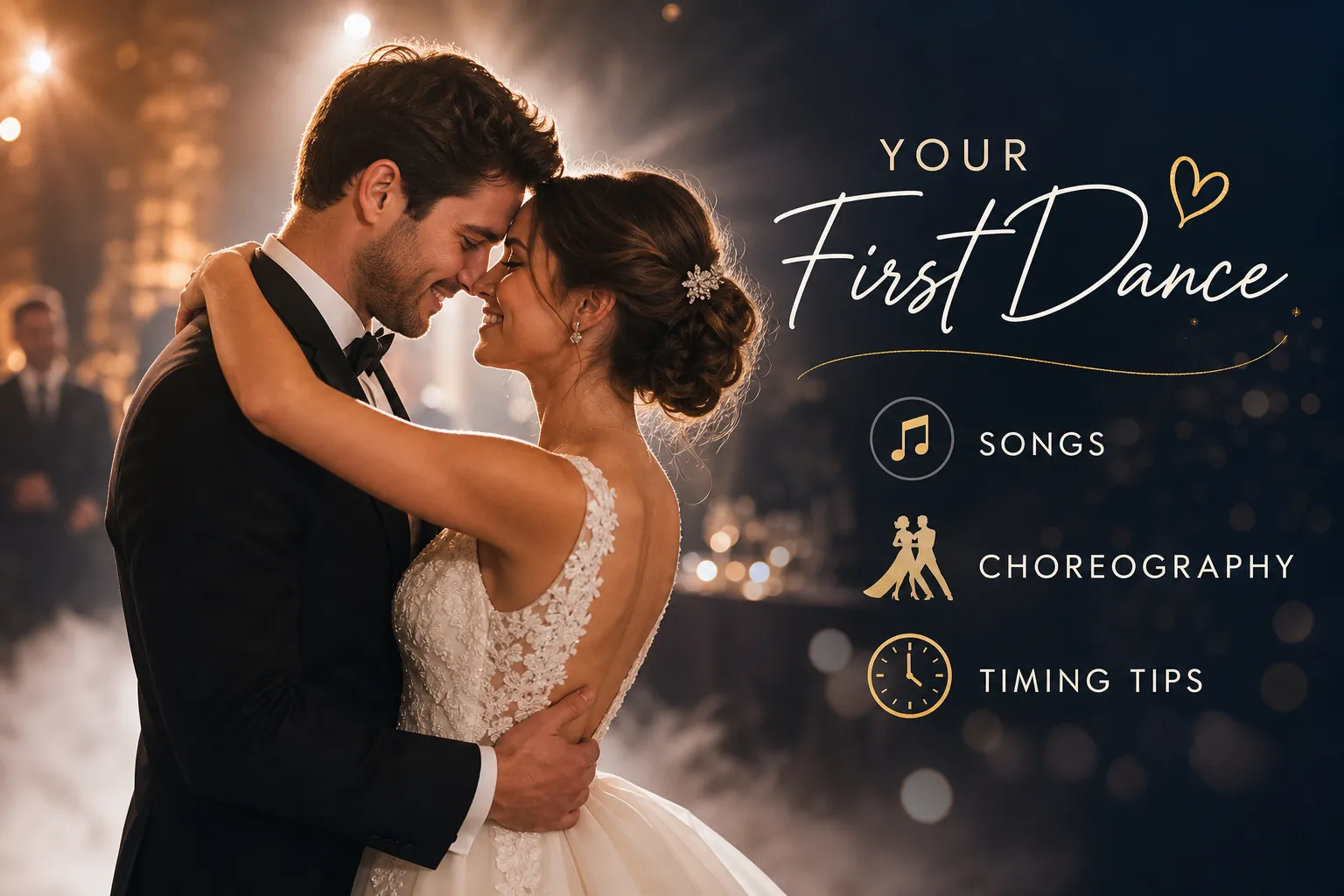
Here’s the thing about your wedding first dance: it’s one of those rare moments in the entire day when most guests stop their conversations, set down their drinks, and turn to watch the two of you together. And you’re expected to look completely natural doing it. No pressure.
Most couples carry a mix of excitement and quiet dread about this moment. They want it to be beautiful and personal, but they’ve also never had 100 people watch them move across a dance floor before. The good news is that a great wedding first dance has almost nothing to do with natural talent. It has everything to do with preparation. Couples who walk into their reception feeling ready, whether they’ve practised at home or spent a few sessions with an instructor, are generally perceived as far more confident than those who winged it.
This guide covers the four things that matter most: choosing the right song, editing it to the right length, picking a routine that suits you, and knowing exactly how the evening should unfold so nothing catches you off guard.
Choosing your wedding first dance song
Many couples fall into one of two common traps. They either grab the first romantic song that pops into their head without really thinking it through, or they spend weeks buried in Spotify playlists and end up paralysed by options. Neither approach gets you to a great decision. What does work is a simple framework built around how you actually want to feel on the floor.
Match the song’s vibe to the feeling you want
A slow ballad gives you room to breathe, sway, and look at each other without rushing. A mid-tempo pop track demands a bit more structure and footwork awareness. Before you commit to any song, think about the emotion rather than what sounds impressive. If a particular track makes one of you emotional every time it comes on the radio, that reaction is telling you something. That’s usually the right song.
First dance song ideas: what couples are dancing to right now
In 2026, the standout choices include Alex Warren’s “Ordinary,” Lady Gaga and Bruno Mars’s “Die With a Smile,” and Stephen Sanchez’s “Until I Found You” for couples wanting something current and cinematic. Ed Sheeran’s “Perfect” remains consistently popular in Australia, and Etta James’s “At Last” continues to hold its ground for couples who love a timeless, soulful feel.
For something more intimate and acoustic, The Paper Kites’ “Bloom” or Jack Johnson’s “Better Together” work beautifully at smaller weddings. On the Australian side, INXS’s “Never Tear Us Apart” and Savage Garden’s “Truly Madly Deeply” are genuine crowd-pleasers for couples who want something local and familiar. Treat any list as a starting point, not a rulebook.
The one thing to check before you commit
Tempo. A song that sounds gorgeous in the car can feel completely awkward when you’re actually standing and moving to it. Before you finalise your choice, stand up in your living room and sway to the song. If it feels rushed or unnatural on your feet, it’ll feel that way in front of your guests too, and the choreography will work against you rather than with you.
Getting your wedding first dance length and edit right
Most love songs run between three and five minutes. That’s too long for a first dance. A performance that drags past the three-minute mark stops feeling romantic and starts feeling like a test of everyone’s patience, including yours.
Two to three minutes is the sweet spot. It’s long enough to feel meaningful and short enough that guests stay genuinely engaged. If you’re less confident on the floor, aim for closer to 90 seconds using a single verse and chorus. If you have a bit of choreography, you can comfortably fill two and a half to three minutes without the energy drooping.
Which parts of the song to keep
The most common edit uses the first verse and first chorus, roughly the first two minutes, which captures the song’s main emotional arc and hook. A practical way to think about it: keep verse one from around 0:00 to 0:40, then ride the chorus through to about 1:10, and if you want a slightly fuller version, bring in the bridge before a final chorus to land somewhere between 2:30 and 3:00. The key is avoiding repetitive sections and long instrumental breaks that leave you standing there with nothing to do. If a particular lyric means something specific to the two of you, flag it early so the edit preserves that moment.
Working with your DJ or band on a custom cut
You don’t need to edit audio yourself. A good DJ or band can create a custom clip that captures all the right emotional moments and fades cleanly at the end. Brief them on which lyrics matter most and whether there are any musical shifts you want to time a specific move around, like a turn at the start of the chorus or a dip on the final note. Get confirmation that they have your edited version loaded and ready well before the night.
Simple first dance choreography options when you’re not a natural dancer
This is where most couples either overcomplicate things or give up on structure entirely. Neither extreme serves you well. A thoughtful approach to even the simplest routine makes an enormous difference in how the dance reads to the room.
The classic sway, done properly
The sway has an unfair reputation for looking like two people awkwardly waiting for the song to end. Done well, it’s genuinely beautiful. The difference comes down to posture, connection, and movement. Stand close, maintain a soft frame, shift your weight side to side on the beat, and add a slow, steady rotation so guests see you from all angles rather than just your backs. Practise this for about two to three hours spread across a week and it will look intentional rather than improvised.
Adding a turn or a dip without it looking like an accident
A single well-timed underarm turn or a simple dip at the final note gives the dance a moment that guests genuinely remember. Neither move requires dance experience, just a few practice runs before the night. For the turn, the leader raises one hand and the follower walks underneath. Walk through it slowly first, then add it at a clear musical cue, usually the chorus or the final phrase. Never attempt a dip you haven’t practised several times with careful attention to technique and safety; if you’re considering anything more than a gentle lean, do it under coaching first.
Using the song’s structure to look choreographed
The secret to looking like you planned something, without needing a complex routine, is using the song’s natural shape as your guide. Start with a close sway during the verse. Transition into a step-and-touch or a slow circle during the chorus. Add the turn near the bridge. Return to a close hold for the final note. The song’s structure does the heavy lifting; you just need to know when each section begins.
Why a few professional sessions change everything
DIY choreography has a ceiling. Couples who practise entirely on their own often look rehearsed in a stiff, mechanical way rather than confident and natural. That tension reads clearly on the floor, and more importantly, it shows in the photos and video.
A dance instructor doesn’t just teach you steps. They correct your posture, adjust the frame, add detail to your hold, and tell you exactly where to look. The difference between a self-taught first dance and a coached one tends to show up almost immediately. Coached couples move with intention, and that quality translates directly into every image from the evening.
How Salsa Suave approaches wedding first-dance coaching
At Salsa Suave Dance Studio in Sydney’s CBD, lead instructor Fernando Providel brings extensive experience helping couples build first dance routines that feel personal rather than generic. Private sessions are available seven days a week at the studio on Pitt Street, one block from Town Hall Station, so it’s genuinely accessible whether you’re coming from the city or the suburbs. Each session is built around your specific song, your comfort level, and how much time you have before the wedding day. Many couples find that a polished, confident routine comes together over three to five sessions, and flexible packages mean you can book what you actually need without over-committing upfront.
The first session typically covers establishing a solid frame and hold, learning the basic footwork for your chosen style, whether that’s a slow waltz feel, a Latin-influenced rhythm, or a well-structured sway, and mapping out where each element sits within the song. You leave with a written breakdown to practise between sessions. By session two or three, the routine stops feeling mechanical and starts feeling like yours.
First dance etiquette and how to time it on the night
Couples often put so much energy into the dance itself that they overlook the logistics of when and how it actually happens at the reception. Getting the timing right means the moment lands with the impact it deserves.
The two timing options most couples use
Your opening dance happens either directly after your grand entrance, before dinner, while all guests are seated and paying attention, or immediately after speeches and cake cutting as the transition into open dancing. Both approaches work well for different reasons. The post-entrance option suits couples who want to get it done before nerves have had an hour to build, and it guarantees every guest is watching. The post-dinner option is more traditional and creates a natural energy shift from the formalities into the party portion of the evening.
The typical Australian reception order to follow
A standard sequence at Australian weddings runs: grand entrance, welcome address, entrée, speeches and toasts, main course, cake cutting, first dance, parent dances, and then open dancing for guests. This order is flexible depending on your venue and preferences, but keeping your first dance just before the floor opens to everyone is the most common approach locally. It signals clearly to your guests that the dancing is beginning and creates a momentum shift the room can feel.
Briefing your MC, DJ, and band before the night
Your MC and DJ need to know precisely when the first dance is happening, how they’re introducing it, and whether guests are invited to join at the end of your song or wait for a second track. Confirm with your DJ which edited version of the song is queued and do a brief walk-through in the venue space to check the floor size and where the speakers are positioned. Plan around 30 minutes for this kind of tech and venue walk-through, the exact time will vary by venue, but having that buffer prevents last-minute chaos that can throw a couple’s focus before they even reach the dance floor.
Wedding first dance: bringing it all together before the big night
A confident, memorable wedding first dance doesn’t require a lifetime of dance experience. It needs a song that genuinely suits you, a well-edited track that doesn’t overstay its welcome, a simple routine you’ve actually practised, and a clear plan for how the evening unfolds. Many couples report wishing they’d started their preparation sooner, so if the wedding is approaching, now is a good time to begin.
If you’re in Sydney and want something more polished than a self-taught sway, a few private first-dance lessons at Salsa Suave Dance Studio will give you both the routine and the genuine confidence to enjoy every second of the moment. Fernando and the team are ready to help you walk onto the reception floor feeling completely prepared.
That’s the whole point of all this preparation, after all. Not to perform for your guests, but to actually be present and enjoy the moment you’ve been looking forward to all year.
 CALL US1300 724 442
EMAIL US info@salsasuave.com.au
VISIT US::
CALL US1300 724 442
EMAIL US info@salsasuave.com.au
VISIT US:: 
