

One-on-one dance tuition that fast-tracks your progress
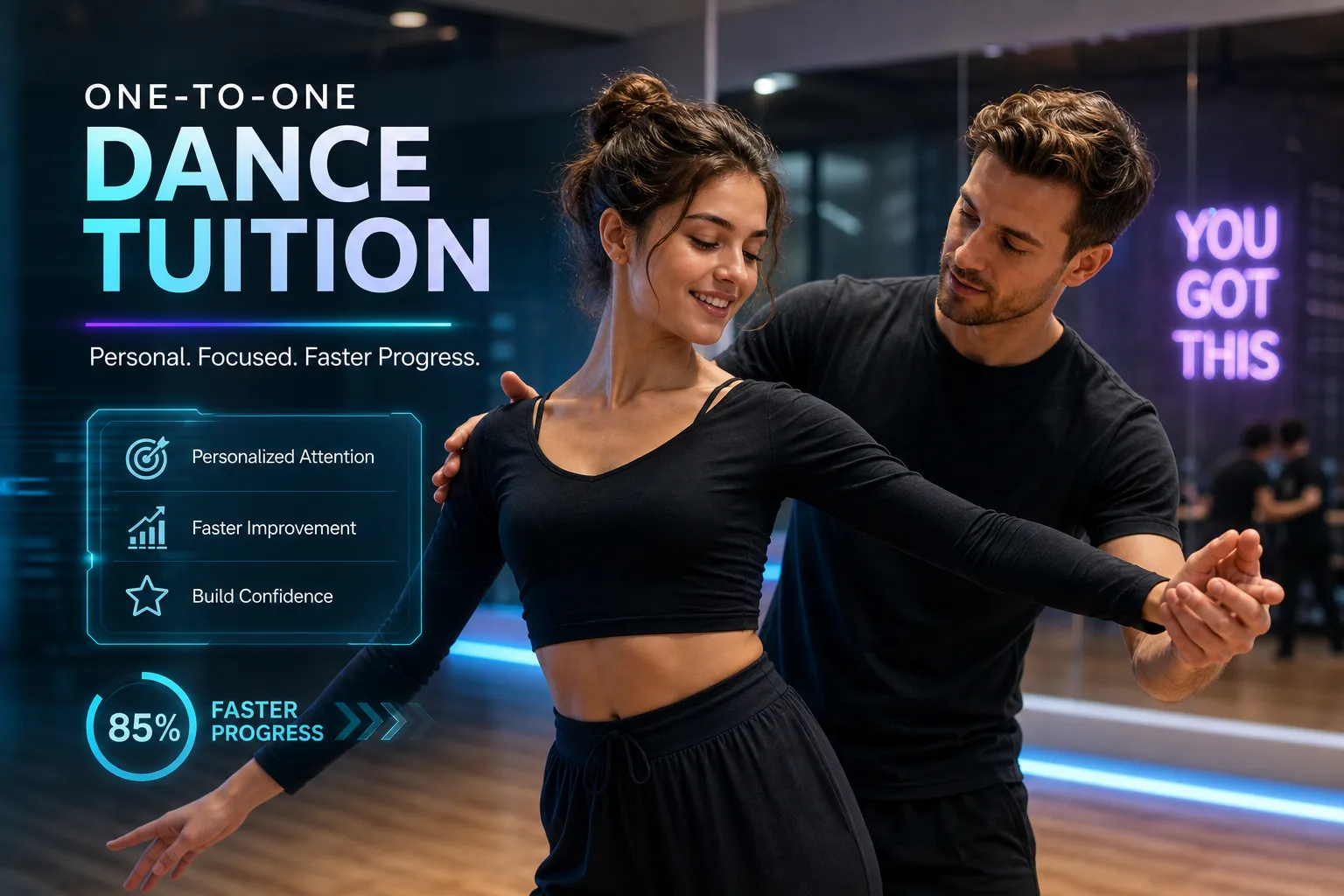
You sign up for a group salsa class. The music is great, the vibe is fun, and you leave feeling like you almost got it. Then you go back the following week and realise the class has moved on, the instructor is teaching a new combination, and you’re still not sure your footwork from last week was right. Sound familiar? For many adult learners, group classes are a fantastic introduction to Latin dance, but they hit a ceiling fast. One on one dance tuition is the practical answer for anyone who wants to stop guessing and start progressing.
Studios like Salsa Suave Dance Studio in Sydney offer private tuition seven days a week, with every session structured entirely around the individual in front of the instructor. No fixed curriculum, no group pace to keep up with, no waiting your turn for a correction. This article covers what actually happens in a private lesson, why personalised feedback accelerates progress, who benefits most, what you’ll pay in Australia, and how to choose an instructor worth your time and money.
What actually happens in one on one dance tuition
Many people assume a private lesson is just a group class with fewer bodies in the room. It isn’t. From the moment you walk in, a well-run session typically begins as a diagnostic exercise. A skilled instructor usually spends the first few minutes assessing where you are: your posture, your timing, how you hold tension in your arms, whether you’re counting in your head or listening to the music. That assessment shapes everything that follows in the next 60 minutes.
The standard session length for private dance coaching is 60 minutes. That’s enough time to warm up properly, work through specific technique, apply it to a short sequence, and leave with something concrete to practise. Unlike a group class where the instructor rotates between eight or twelve students, every correction, every demonstration, and every repetition in a private session is directed at one person.
How session structure differs from group classes
Group classes follow a fixed curriculum designed for the average student in the room. If you’re struggling with timing and the rest of the class has it down, the class moves on regardless. Private one-on-one dance lessons adapt in real time. If your weight transfer is off, the instructor stops and addresses it immediately. If you nail the basic step faster than expected, the session moves forward. The programme is entirely responsive to what’s happening in front of the instructor, including a student correcting a weight-transfer issue they’d been carrying for months without realising it.
What a typical 60-minute private session looks like step by step
A well-structured private lesson follows a clear arc. The first five to ten minutes cover a brief warm-up and goal-setting: what are we working on today, and what did you practise since last time? The next 30 to 35 minutes is the core of the session, focused technique work with live feedback on every repetition. The following 15 minutes applies that technique to a short sequence or routine so it doesn’t stay abstract. The final five minutes is a recap: what was covered, what to practise before the next session, and what the next lesson will build on. That structure gives you a clear sense of progress after every single class.
Why personalised feedback speeds up your learning
The strongest argument for private coaching is efficiency. Experienced instructors consistently report that one focused private lesson can deliver skill gains equivalent to several group classes, because it eliminates time spent waiting for corrections, keeping pace with others, or reinforcing movements that aren’t quite right. A personal dance instructor working with just you can identify exactly what is holding your progress back, rather than teaching to the average of the group.
There’s a psychological benefit too, and it’s not a small one. In a group setting, adults often feel self-conscious about asking for clarification or admitting they’re lost, and that anxiety slows physical learning. In a private setting, there’s no audience, no comparison, no pressure to keep up. For adult beginners especially, that psychological safety translates directly into faster physical progress. For more on how dance classes benefit adult learners, see this summary of the wider benefits of dance classes for adults.
The compounding effect of immediate correction
Errors that go uncorrected in group classes don’t disappear. They become habits. A beginner who attends six group classes with a slightly off timing pattern has now practised that incorrect timing hundreds of times. One-on-one dance tuition catches these errors early, before they become ingrained. In many cases, targeted private sessions can reverse weeks of reinforced incorrect technique far more efficiently than hoping the habit resolves itself in a group setting.
How instructors adapt to your learning style in real time
Some students are visual learners who need to watch a movement broken down slowly before they try it. Others respond better to a verbal cue or a physical prompt about where the weight should be. A skilled private instructor typically reads this within the opening portion of a session and adjusts their entire approach accordingly. That kind of adaptive teaching is genuinely impossible when managing twelve students at once, which is why group classes, even excellent ones, can only take you so far.
Who gets the most from private dance lessons
One on one dance tuition isn’t the only way to learn to dance, and it’s worth being honest about that. Group classes offer community, social practice, and a lower entry cost. But for certain learners, private 1:1 dance coaching is clearly the more productive option. Salsa Suave Dance Studio structures its private programme around four distinct goals: building foundational confidence, refining technique at an intermediate level, preparing a wedding dance routine, and developing skills for Sydney’s Latin social dance scene.
Beginners who want results without the overwhelm
A complete beginner in a group class is expected to absorb new information at the same pace as everyone else, regardless of their athletic background, coordination, or prior experience. Private lessons remove that pressure entirely. A beginner can spend the entire session on the basic eight-count step if that’s what’s needed, and move forward only when the foundation is solid. Most adult beginners establish comfortable basic salsa footwork and timing within four to six dedicated private sessions, particularly with consistent practice between lessons.
Couples and wedding dance tuition
A private lesson for two people is a fundamentally different experience from a couples group class. The instructor watches both partners simultaneously, coaching the dynamic between them rather than just individual technique. Lead-and-follow mechanics, connection, and timing as a unit all require that dual focus. For couples preparing a wedding first dance with a fixed date on the calendar, that efficiency matters enormously. You’re not wasting a single session on curriculum that doesn’t apply to your routine, if you need choreography guidance, consider the studio’s first dance choreography options tailored for couples.
Intermediate dancers breaking through a plateau
Intermediate dancers often reach a point where attending more group classes produces diminishing returns. The fundamentals are there, but something specific is limiting progress: a turn that’s slightly off balance, a body movement that isn’t landing, a rhythm issue that only appears with faster music. Private choreography lessons and targeted technique work are purpose-built for exactly this situation. Rather than attending another twenty group classes hoping the issue resolves itself, one targeted private session can identify and address the specific problem directly.
One on one dance tuition costs in Australia
Average hourly rates for private tutors across Australian cities sit at roughly $32 in Sydney, $30 in Melbourne, $25 in Brisbane, and $39 in Perth. These figures reflect general private tutor averages, not specialist studio rates, regional variation is driven largely by local market size and cost of living. Specialist Latin dance instructors at established studios typically charge between $50 and $120 per session, reflecting years of performance and teaching experience. For context, Salsa Suave Dance Studio’s pricing starts at $140 for a single private lesson and scales through structured packages to the 50-lesson Ultimate Package at $4,950, which works out to $99 per lesson. For a broader breakdown of typical dance lessons cost guide, consult a national pricing summary.
The value logic behind packages is straightforward. A single casual lesson is useful for a trial, but consistent progress requires consistent sessions. Committing to a package upfront reduces the per-lesson cost significantly, and, practically speaking, keeps you showing up. Lessons you’ve already paid for are lessons you attend. For most adult beginners aiming to feel genuinely confident on the social dance floor, instructors generally suggest a minimum of eight to twelve sessions as a realistic foundation, which makes package pricing worth evaluating from the outset. If you want a view of typical rates for dance classes in different cities, that can help you benchmark local studio pricing.
How to evaluate package value before you commit
The maths is simple. Divide the total package price by the number of lessons and compare that per-lesson rate against the casual rate. At Salsa Suave, a single lesson is $140; committing to a package brings that per-lesson cost down considerably. For couples, Salsa Suave offers partner pricing, check the studio’s current pricing page for the exact terms, which can represent genuine value when you’re preparing a wedding routine or simply learning together. The key is not to commit to a large package until you’ve done at least one trial session and confirmed the instructor is the right fit for your goals.
What to look for in a private dance instructor
Formal qualifications are worth checking. In 2026, the Diploma of Dance Teaching and Management (CUA50325) is increasingly the benchmark credential for serious instructors, though a Diploma of Dance (Latin and Ballroom) such as 11254NAT also demonstrates structured training in both pedagogy and technique. The Certificate IV in Dance Teaching and Management (CUA40320) remains common and is a reasonable baseline. That said, practical experience and specialisation matter just as much as credentials on paper. An instructor with ten years of Latin performance and teaching experience is often more valuable than one with a qualification but limited real-world practice. For further context on the occupation and expected qualifications, see the government occupation profile for dance teachers.
Insurance is non-negotiable, any reputable private instructor should hold public liability cover. If you’re booking for a minor, confirm that the instructor holds the relevant Working with Children Check for your state: a WWCC in New South Wales, or a Blue Card in Queensland.
Qualifications and experience that actually matter
Look for instructors who specialise in the specific style you want to learn, not generalists who teach everything from ballroom to hip-hop. Verify that they can demonstrate the technique themselves, not just describe it. Check whether they have taught students at your level before, and whether those students achieved the goals you’re setting for yourself. A teacher’s track record with beginners is a better predictor of your experience than any qualification alone.
Questions to ask before you book your first session
Before committing to a studio or instructor, ask these directly:
- How many years have you been teaching this specific style?
- Do you offer a trial or first lesson before I commit to a package?
- What happens if I need to reschedule? What is your cancellation policy?
- Are you insured for public liability?
- What does progress typically look like for a student at my level after five lessons?
- How do you approach complete beginners versus students who have plateaued?
A confident, experienced instructor will answer all of these without hesitation. Vague or evasive answers are a clear signal to keep looking.
How to find the right studio and take your next step
If you’re in Sydney, Salsa Suave Dance Studio at 262 Pitt Street in the CBD is a practical starting point for private one-to-one dance tuition. The studio is one block from Town Hall Station, which makes it straightforward to reach from most parts of Greater Sydney. Private lessons are available seven days a week from 9am to 10pm, so finding a time that fits around your schedule is rarely an issue.
Instruction covers salsa, bachata, mambo, and cha-cha-cha, with sessions designed for every level from absolute beginner through to advanced performance training. Lesson packages start at a single $140 session, which means you can try before committing to anything more. For couples, contact the studio directly to confirm current partner pricing terms and find the option that suits your goals. If you have an interest in other ballroom styles, the studio also lists its Tango dance classes in Sydney.
What to do at your first private lesson to get the most from it
Arrive with a clear goal in mind, even a rough one: “I want to feel comfortable on the dance floor at a Latin night” or “I have a wedding in four months.” Wear comfortable shoes you can move in, for Latin dance specifically, a low heel or flexible flat with a smooth sole works better than thick-soled trainers. Don’t worry about existing technique or lack of it; the instructor’s job in that first session is to diagnose your starting point, not judge it. Treat the first lesson as a conversation as much as a class. The more clearly you can articulate what you want to achieve, the more effectively the instructor can structure what comes next.
When to consider combining private and group classes
For dancers who want to build solid technique and also develop the social confidence to use it, the most effective approach is often a combination of both formats. Private one-on-one dance lessons build and refine the mechanics; group classes and social dance nights put those mechanics under pressure with different partners, different music, and a real social environment. This combination is particularly effective for anyone preparing to enjoy Sydney’s Latin dance scene, where confidence and adaptability matter as much as technical precision.
The honest bottom line
One on one dance tuition is not the only path to learning Latin dance, but for adults who want measurable progress without wasted sessions, it is the most efficient option available. Know what a well-structured private session looks like. Price it against your budget using the figures here. Ask the right questions before committing to an instructor. Choose a studio that specialises in the style you actually want to learn.
If you’re based in Sydney, Salsa Suave Dance Studio offers a straightforward entry point: a single trial lesson to test the fit before any larger commitment. If you’re elsewhere in Australia, use the checklist above when evaluating any private Latin dance instructor. The right instructor for your goals exists, it’s just a matter of knowing what to look for before you book.
 CALL US1300 724 442
EMAIL US info@salsasuave.com.au
VISIT US::
CALL US1300 724 442
EMAIL US info@salsasuave.com.au
VISIT US:: 
