

Is Salsa or Bachata Easier to Learn as a Beginner?
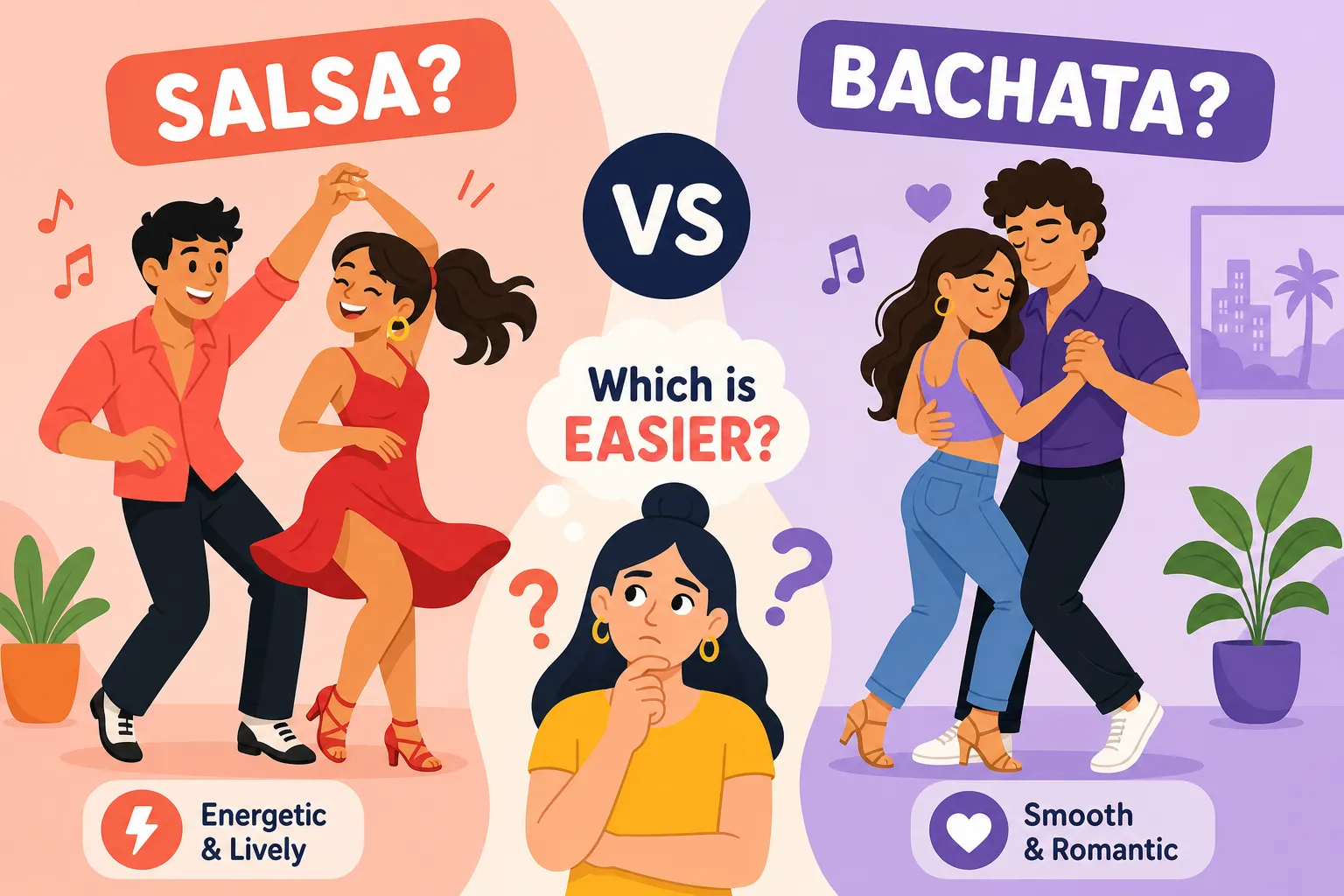
If you’re asking whether salsa or bachata is easier to learn as a beginner, you deserve a direct answer rather than the usual “both are great!”, which is technically true and practically useless. Most beginners walk into their first Latin dance enquiry with exactly this question and walk out with a vague, well-meaning non-answer that doesn’t help them decide anything.
Salsa and bachata are genuinely different dances that ask different things of a beginner’s body, ears, and patience. One is not simply a harder version of the other. After watching hundreds of complete beginners work through both styles at Salsa Suave Dance Studio, the answer is almost never one-size-fits-all. What works depends on your goals, your relationship with rhythm, and how quickly you want to feel comfortable on a social dance floor.
Here is a straight comparison across timing, footwork, social readiness, and partner connection so you can make an informed decision rather than guessing.
Is salsa or bachata easier to learn as a beginner? Start with the timing
This is the single biggest technical gap between the two styles, and it catches beginners by surprise. The challenge is not just learning steps, it is learning how to hear the music and match your feet to it. Both dances use the same eight counts of music, but they interact with those counts in completely different ways.
Salsa’s quick-quick-slow rhythm
Salsa steps land on beats 1, 2, 3 and then 5, 6, 7. Beats 4 and 8 are treated as pauses. That “quick-quick-slow” rhythm creates an uneven, syncopated feel that many beginners find difficult to internalise at first. Most salsa music at social events runs between 150 and 220 BPM, which leaves very little room for hesitation. The pause is not a rest; it is part of the pattern, and stepping on it is one of the most common early mistakes new dancers make.
Bachata’s steady four-count flow
Bachata is more predictable. Four even steps, then a hip tap or bump on beat 4, then repeat. No skipped beats, no syncopation. Beginner-friendly bachata tracks typically sit between 108 and 125 BPM, considerably slower than social salsa. The rhythm is symmetrical and consistent, which means a beginner can usually find their footing within the first few sessions rather than spending weeks just trying to locate the beat.
Footwork, turns, and where the real difficulty gap appears
Timing is one thing. What your body actually has to do is another. The physical and technical demands of each style are genuinely different, and it is worth being clear-eyed about what you are signing up for.
What salsa asks of your feet from day one
Salsa footwork is compact, directional, and fast. The steps require sharp weight changes and precise foot placement. Turns are introduced early, often within the first few weeks, and turning right and turning left are technically different patterns in salsa, meaning beginners effectively learn two separate turning sequences. The spin-heavy nature of the dance means coordination challenges stack up quickly, even before you add a partner into the equation.
Why bachata is more forgiving to start
Bachata uses larger, smoother steps with a grounded quality. The hip movement on beat 4 is a physical anchor, not a trap, it gives beginners something to aim for rather than a void to fill. Basic bachata does not rely heavily on turns, which keeps the mental and physical load lower in the early weeks. Most experienced instructors regard bachata as the more accessible entry point of the two, and the technical reasons back that up.
How long before you can actually dance at a social event?
This is the question most beginners really want answered. Honest timelines matter more than vague encouragement, so here is what consistent practice actually produces.
Bachata: weeks to your first real dance
With consistent attendance at one or two classes per week, plus a social practice night, most beginners can hold their own on a bachata floor within two to four weeks. The mechanics absorb quickly because the rhythm is predictable and the steps are physically intuitive. By the one-to-three-month mark, most people have enough patterns and confidence to dance socially without counting out loud or freezing mid-song.
Salsa: a longer but deeply rewarding commitment
Salsa’s complexity means social competency typically takes three to six months for a complete beginner. The first four to six weeks are heavily focused on timing and basic footwork, not a slow start, but the necessary foundation. The payoff is real: by the three-month mark, most students can lead or follow basic patterns reliably, and by six months the movement starts to feel genuinely natural rather than mechanically assembled.
Partner connection: how lead and follow skills develop in each style
Most beginners do not realise that partner communication in salsa and bachata works differently, and that this affects how quickly you feel confident dancing with someone you have never met before.
Leading in salsa vs bachata for new dancers
Leaders face the harder initial challenge in both styles. They must memorise patterns, plan transitions, and communicate direction at the same time. Salsa demands that leads are prepared earlier, because the tempo is faster and turns require clear preparation signals well ahead of the movement. Bachata’s slower pace gives leaders more time to settle into each movement before signalling the next, which makes the communication feel less rushed and more manageable early on.
Following: which style is easier to react to?
Following is generally the more accessible role for brand-new dancers in both styles, because it requires responding to signals rather than generating them. Bachata’s slower tempo and grounded movement quality make it easier for followers to read the lead and stay connected. Salsa’s speed and higher turn volume increase the demand on followers faster as they progress. For absolute beginners, bachata gives followers more time and clarity to respond without feeling overwhelmed.
Which style actually matches your goals?
The answer depends less on what is “easier” in the abstract and more on what you want from learning a Latin dance. The comparison only matters in relation to your actual situation.
If you want to socialise and feel confident quickly
Bachata is the more logical starting point for beginners. The learning curve is gentler, social nights in Sydney regularly feature bachata sets, and the close-connection style makes it inherently welcoming for new social dancers. If your goal is to feel comfortable on a dance floor within a couple of months, bachata gets you there faster. The wins come earlier, and that momentum matters when you are just starting out.
If you are drawn to energy, musicality, and challenge
Salsa rewards the longer investment. It is more musically demanding, more technically varied, and the Latin dance night scene in Sydney runs heavily on salsa. The music is fast, the movement is expressive, and the skill ceiling is genuinely high. If you are motivated by the idea of eventually moving fluently through a room full of experienced dancers, salsa’s difficulty is part of the appeal rather than a deterrent. The three-to-six-month investment is worth it for the right person.
The most practical way to stop overthinking and start dancing
Most people who ask which dance is easier are really asking which one they will actually enjoy. That question cannot be answered from an article. Abstract comparisons only take you so far when the experience is entirely physical.
Why a short trial lesson in each style is worth more than any article
The best way to find out which style clicks is to get in a room, hear the music, and move to it. One beginner private lesson in bachata and one in salsa tells you more about your personal fit than hours of research. The steps, the music, and the feeling of partner connection are all physical and personal. Most people know within the first lesson which style they want to pursue.
How to try both without committing to a full programme
For beginners in Sydney wanting to sample both styles before choosing, Salsa Suave Dance Studio offers introductory private lessons in both salsa and bachata. The sessions are tailored to your pace, available seven days a week from 9am to 10pm, and the studio is located on Pitt Street in the CBD, one block from Town Hall Station. A single lesson in each style is enough to know where your instinct points. No prior experience required, and you do not need to bring a partner.
So, is salsa or bachata easier to learn as a beginner?
For most people, bachata is the more accessible starting point. The timing is consistent, the footwork is simpler, and social confidence comes faster. Salsa has a steeper but genuinely rewarding curve, and for many people, the challenge is exactly what makes it worth pursuing. Both are worth learning, and most committed Latin dancers eventually pick up the other style within a year of starting the first.
Every experienced Latin dancer started exactly where you are: uncertain, curious, and one first lesson away from something they will do for years. The only real mistake is waiting too long to find out which one is yours.
 CALL US1300 724 442
EMAIL US info@salsasuave.com.au
VISIT US::
CALL US1300 724 442
EMAIL US info@salsasuave.com.au
VISIT US:: 
