

Salsa vs bachata: which is easier to learn first?
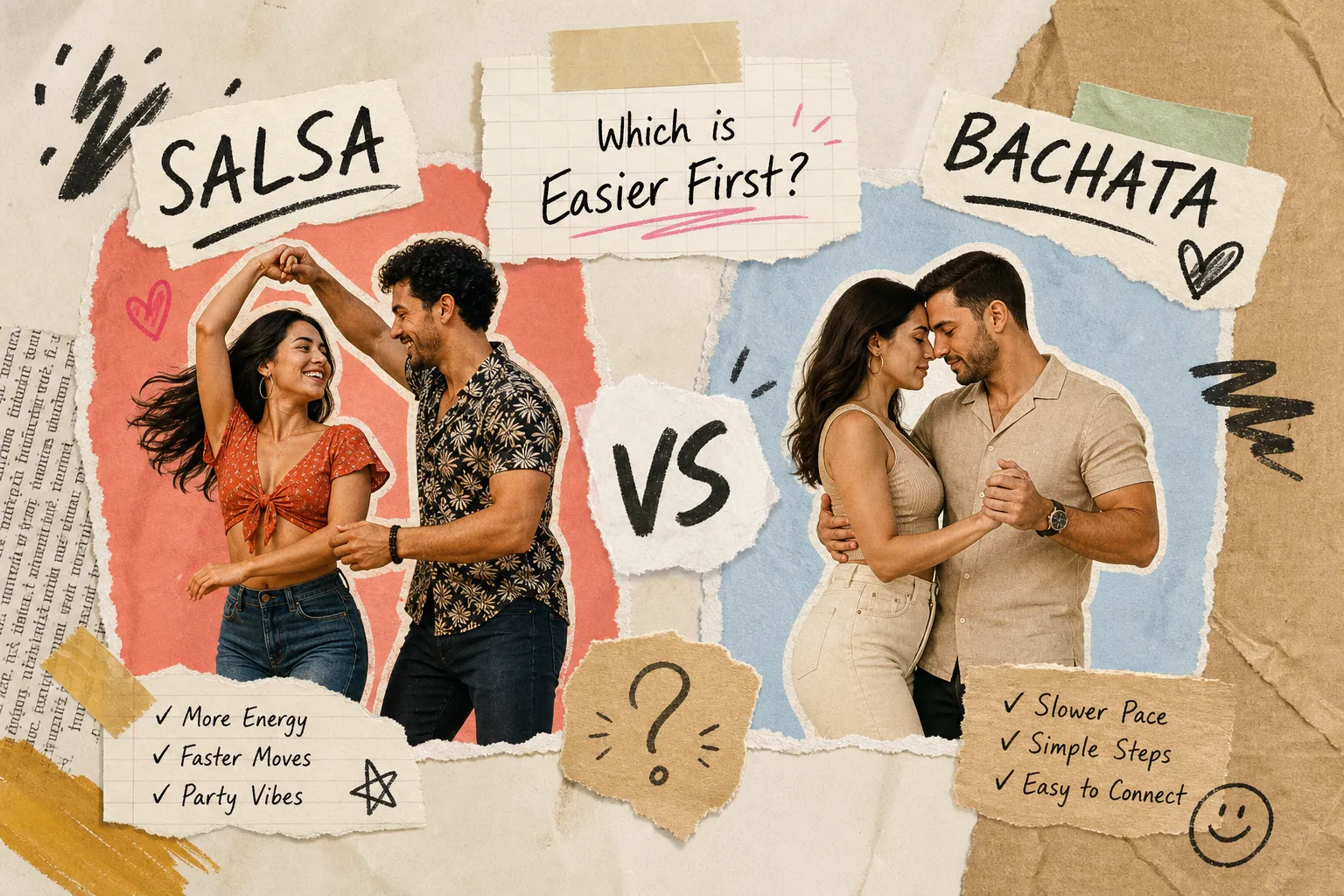
Is salsa or bachata easier to learn as a complete beginner? At Salsa Suave Dance Studio, this is the most common question we get in first enquiries, and after years of teaching both styles in Sydney, we have a real answer, not a carefully worded non-answer designed to avoid committing. You’ve probably stood at the edge of a Latin night watching the floor fill up, trying to work out whether the couple near the bar is doing salsa or bachata. You’ve Googled the question, read three articles that all said “it depends,” and you’re no closer to actually booking a class. That stops here.
By the time you finish reading, you’ll know the actual technical differences between the two dances, which style gives most complete beginners a smoother entry point, what realistic timelines look like for each, and the one practical step that will end the second-guessing for good.
What actually separates salsa from bachata at the technical level
How the basic steps differ
Both dances use an eight-count structure, stepping on beats one, two, three and five, six, seven. That’s where the similarity ends. Salsa uses a forward-and-back basic that travels along a line or slot, while bachata moves side-to-side with a tap or hip accent landing on beat four. The direction of travel feels completely different from your very first lesson. That bachata tap gives the dance a steady, predictable anchor point, and many beginners find it easier to feel in the body before they can intellectualise why.
The body mechanics matter here too. Bachata’s side-to-side basic uses small lateral weight shifts with the steps close under your body, so your balance stays centred throughout. Salsa’s forward-back basic requires you to manage a changing centre of mass as you move through the step, which demands more postural control and timing precision from day one. Neither is wrong; they’re just different physical problems to solve.
Timing, tempo, and partner hold
Salsa music covers a wide range, many social dance tracks sit roughly between 150 and 200 beats per minute, though some recordings run faster or slower depending on the subgenre and arrangement. Bachata sits closer to 120 to 145 BPM. That tempo gap isn’t just a number: it determines how much processing time your brain gets between beats when you’re still building the connection between ear and foot. Slower music gives you more room to hear the beat and coordinate with a partner before you have to execute the step cleanly.
The partner hold also differs in ways that matter for beginners. Bachata is danced closer, in a more compact frame, which means you can physically feel your partner’s weight shifts rather than having to read them from a distance. Salsa uses a more open frame to accommodate travelling patterns, cross-body leads, and spins, and those turn patterns arrive earlier in the salsa learning curve than they do in bachata.
Salsa On1 and On2 basics, and why it matters for beginners
Salsa adds one more variable that bachata doesn’t: timing style. The two most common systems you’ll encounter in Sydney studios are On1 (also called LA style) and On2 (New York style). In On1, the leader breaks forward on beat one; in On2, the break happens on beat two. For complete beginners, On1 is generally the recommended starting point because the break falls on the most obvious downbeat, making it easier to find and hold the rhythm while you’re still building muscle memory. On2 has a more syncopated feel that many dancers prefer once their ear is trained, but trying to learn it before your basic is automatic adds unnecessary complexity. When you’re comparing salsa or bachata as a beginner, it’s worth knowing that the style of salsa you’ll be taught matters, a good studio will make that choice deliberate and explain why.
Is salsa or bachata easier to learn as a complete beginner? Here’s the practical answer
Why bachata tends to be the more accessible starting point for beginners
For most complete beginners with no prior dance experience, bachata is the more accessible entry point. The slower tempo and side-to-side basic give your brain more processing time and a simpler mechanical problem to solve, while the close hold lets you feel your partner’s movement rather than read it from a distance. The tap on beat four also gives you a reliable reset point when you lose your place, something salsa’s forward-back basic doesn’t provide in the same way.
Early momentum matters more than most people realise in the first weeks of learning a partner dance. Students who can feel the beat and execute the basic cleanly by lesson three are far more likely to stick with it than those who feel lost for the first month. Bachata’s slower tempo and simpler footwork tend to deliver that early sense of progress faster, and that momentum compounds quickly once you start attending social nights.
When salsa might actually suit you better
This isn’t a clean-cut rule. Some people have a natural affinity for faster, more rhythmic styles. If you grew up listening to uptempo Caribbean music, or you already have rhythm training from another activity, salsa may not feel significantly harder. The critical variable is natural fit, not some objective difficulty rating that applies to everyone equally.
The most reliable way to find out which style suits you is to move to both types of music with an experienced instructor watching. A good teacher will run a simple first-lesson rhythm check: clapping to the beat, stepping in time, counting through an eight-count pattern. From that, they can tell whether you’re picking up the pulse easily or whether you need a more structured approach, and they’ll point you toward whichever style gives you the best starting conditions.
Realistic timelines to reach social competency in salsa or bachata
What the salsa learning curve looks like month by month
Most beginners find that the salsa basic starts to click around weeks four to six with consistent attendance. At that point, you can execute the step without counting aloud, and simple turn patterns begin to feel manageable rather than chaotic. Attending social events with genuine confidence typically happens around the eight-to-twelve-week mark for students who attend weekly classes and do even short practice sessions at home between lessons.
Full social competency, meaning you can lead or follow a handful of basic patterns with different partners, stay on rhythm through a whole song, and recover from mistakes without stopping, usually lands somewhere between three and six months. That timeline assumes consistent attendance rather than sporadic drop-ins. Social competency doesn’t mean perfection; it means you can get out there, keep moving, and actually enjoy yourself on the floor.
How bachata progression compares
Bachata timelines run slightly faster for most beginners. Many students feel comfortable attending social nights after two to three months, with confident and relaxed social dancing arriving closer to four to six months. The milestone pattern follows a similar sequence to salsa: basics feel automatic first, then simple turns become reliable, then partner connection improves and you stop thinking about your feet. The slower tempo and simpler footwork mean most people hit each of those milestones with less frustration along the way.
Frequency matters more than total weeks on the calendar. A student who attends once a week and spends ten minutes practising at home between lessons will progress significantly faster than someone who shows up twice a month and does nothing in between. Even basic solo practice, stepping the count at home while listening to the music, compounds quickly over the first few months.
Where each style takes you in Sydney’s social dance scene
The bachata social culture
Sydney’s bachata scene has a genuinely welcoming culture for newer dancers at social nights. The closer hold creates an intimate, conversational dynamic on the floor that feels different from most other partner dances, and that closeness works in a beginner’s favour: connection is easier to feel and maintain when you’re dancing in a compact frame. Before you attend your first social, it’s worth knowing that you may encounter both traditional bachata and bachata sensual on the same night. Traditional bachata is more footwork and rhythm focused; sensual bachata layers in body waves, torso isolations, and a more expressive upper body. Start with traditional fundamentals and you’ll be able to participate in both without feeling lost.
The salsa scene and why it’s worth the extra effort
Salsa nights in Sydney are energetic, and the variety of moves on display can feel intimidating when you’re still learning your basic step. That’s a completely normal reaction. Once your fundamentals are solid, that same energy becomes part of what makes salsa social dancing so enjoyable. Sydney has an active Latin social dance community with regular nights across the CBD, Darling Harbour, and inner suburbs including Surry Hills and Marrickville, and knowing either style opens up a genuinely social life beyond the studio.
Regular social events throughout the city mean you won’t be waiting long to test what you’ve learned in a real setting. That access to live social dancing is one of the best accelerators for progress once your basics are in place.
How to choose your starting style and stop second-guessing
The one thing that actually settles the question
In our experience, the students who agonise longest over which style to start with are almost always the ones who haven’t moved to either type of music yet. Reading articles, including this one, can only take you so far. The most reliable approach is to take a first lesson in both styles within a few weeks of each other and let your body give you the answer. Your natural sense of rhythm, your coordination, and the way you respond to each style of music will tell you more in one session than any comparison article can.
An experienced instructor can assess all of this in real time during that first lesson. They’re watching whether you find the beat easily or need more counting support, whether you pick up the weight transfer quickly or need it broken into smaller pieces, and whether the music itself seems to move you before you’ve even been taught a step. From that, they’ll give you a clear recommendation rather than leaving you to guess.
Starting at a studio that teaches both under one roof
At Salsa Suave Dance Studio, we teach both salsa and bachata, which means you’re not locked into one path before you understand what suits you. Private lessons are particularly useful at the start of your dance journey because the instructor can watch you move, identify where your natural strengths sit, and build your first few lessons around the style that will give you the fastest, most enjoyable entry into partner dancing. The session is built entirely around your pace, your coordination, and your goals, rather than keeping pace with a larger group.
The studio is led by an instructor with extensive teaching experience across both styles and a background assessing complete beginners from their very first lesson. That depth of experience makes the style recommendation a straightforward conversation rather than a lengthy process. Private lessons are available most days of the week, and the studio is located in the Sydney CBD within easy reach of Town Hall Station. Check the booking page for current availability and session options and also for Wedding dance Lessons for couples getting married.
The honest answer
For most complete beginners, bachata offers a slightly smoother entry point. The slower tempo, simpler footwork, and closer partner hold reduce the number of things your brain has to manage simultaneously in those first critical weeks. But the right answer for you personally depends on your rhythm, your musical ear, and what you want the dance to lead to socially. Neither style is a poor choice; both will build the coordination, musicality, and partner connection that carry across to other Latin dances as you progress.
The fastest way to stop debating and start progressing is to take a first lesson. You now understand the real differences between the two styles, which means you’ll walk into that first session informed and ready to have a productive conversation with your instructor about which starting point makes the most sense for you.
Ultimately, if you’re asking whether salsa or bachata is easier to learn as a complete beginner, most people will find bachata gives the gentler start, but the only way to know for certain is to move. If you’re in Sydney, Salsa Suave Dance Studio offers private lessons in both styles from the CBD. Book a session and let the music answer the question for you.
 CALL US1300 724 442
EMAIL US info@salsasuave.com.au
VISIT US::

