

Salsa or bachata: which should beginners learn first?
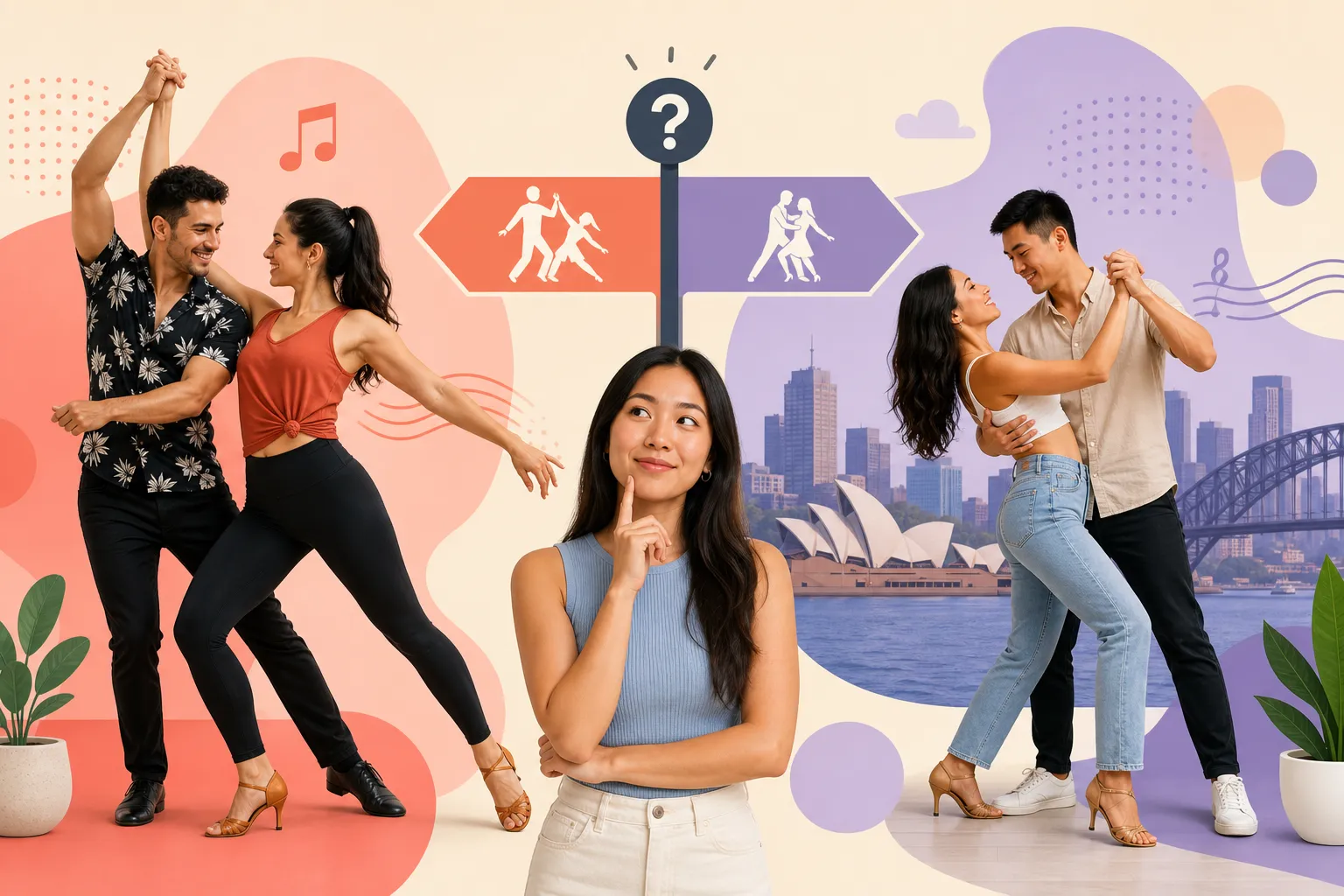
Picture this. You’re standing outside a Latin dance studio, one hand on the door, heart doing its own little rhythm. You booked the appointment weeks ago, certain you’d figure it out before arriving. And yet here you are, still turning the same question over in your head: salsa vs bachata, which should I start with?
For beginners weighing up salsa vs bachata, this is one of the most common questions we hear at Salsa Suave Dance Studio in Sydney before a new student’s very first class. And it makes complete sense. From a distance, both dances look similar: partners moving together, hips swaying, smiles everywhere. Both sound wonderful. Both are genuinely achievable for someone who has never danced a step in their life. That’s exactly what makes the choice feel impossible.
The good news is that this doesn’t have to be a guess. There are real, practical differences between the two styles that make one a better fit for your learning style, your goals, and the way you naturally like to move. Here’s how to figure out which one that is.
How the music feels before you step on the floor
Before you learn a single step, the music will already tell you something useful. Salsa and bachata come from different roots; they have genuinely different sonic personalities, and spending five minutes with a playlist of each is the best preparation you can do before your first class. Which one makes you want to move?
The pulse of salsa: faster, sharper, more driven
Salsa music typically runs between 160 and 185 BPM, with beginner-friendly tracks often chosen near the lower end of that range. It’s built in 4/4 time and organised into 8-beat phrases, layered with clave, congas, brass sections, and call-and-response vocals that give the music its unmistakable forward drive. Even the slowest salsa tracks carry a sense of urgency. The music is moving, and it wants you to move with it.
The feel of bachata: warmer, slower, more melodic
Bachata sits closer to 120 to 130 BPM, roughly 40 to 60 BPM slower than salsa. The sound is guitar-led and more melodic, with a warmer, more romantic quality that gives you genuine breathing room between steps. That extra time matters enormously when you’re still finding your feet. It’s also worth knowing that modern sensual bachata leans into body movement and partner connection, while traditional Dominican bachata is more footwork-driven and rhythmically playful. The style you hear in class shapes what you’ll learn, so knowing the difference early is useful.
Why the music question matters before you choose
Put on a few tracks of each and sit with them for a moment. Which one pulls you in? Which one makes you tap your foot or shift your weight without thinking? The dance you feel more naturally drawn to through its music tends to be the style you’ll enjoy most during the learning process. That’s not a guarantee, but it’s a reliable first signal, and far better than choosing at random.
Salsa vs bachata for beginners: the basic steps explained side by side
Neither set of steps is complicated on paper. The challenge is putting them together with music and a partner. Understanding the patterns first gives you a solid head start.
Salsa footwork: step, step, step, pause
Salsa uses a three-step-plus-pause pattern across 8 counts. You step on beats 1, 2, and 3, pause on 4, then step on 5, 6, and 7, pausing again on 8. The movement travels primarily forward and back along a slot, with sharper hip action and directional changes building as you progress. The pause on beats 4 and 8 is the trickiest part for most beginners, because every instinct tells you to keep moving when the music is this energetic. Holding that pause is the first real skill salsa asks of you.
Bachata footwork: step, step, step, tap
Bachata uses the same 8-count structure but replaces the pause with a tap on beats 4 and 8. Instead of travelling forward and back, the basic step moves side to side. The tap triggers a hip lift and sway that gives bachata its characteristic rolling body motion. Many beginners find the tap-and-hip action more intuitive than salsa’s pause, simply because something is always happening on every beat. There’s no empty count where you have to hold still and trust the rhythm.
Which dance has the gentler learning curve?
The honest answer is that it depends on the person. But there are genuine patterns worth knowing before you book your first class, and this section won’t hedge around them.
Where salsa tends to challenge new dancers
Salsa rewards rhythm awareness early, and that’s a double-edged quality for beginners. Catching the pause, coordinating the cross-body lead, managing the faster tempo, and tracking direction changes while staying connected to a partner all arrive in the first few lessons together. Beginners without prior movement experience can find the first couple of sessions genuinely disorienting. That’s not a reason to avoid salsa, it’s a reason to walk in expecting a learning curve rather than instant flow, and to give yourself permission to feel awkward before you feel good.
Why bachata is often the friendlier entry point
Bachata’s slower tempo and side-to-side simplicity make it more accessible for most complete beginners. The tap on every fourth beat gives you a constant physical anchor in the music, and the emphasis on partner connection and body movement means you start feeling like you’re actually dancing quite early in the process. Many teachers and students report that the social rewards tend to arrive sooner in bachata, which keeps motivation high through those first uncertain weeks. That said, salsa’s energy and the musicality you develop over time are genuinely compelling long-term motivators once the basics settle in.
What your first few lessons will actually cover
Knowing what to expect in a beginner class helps you understand the commitment involved before you choose a style. Here’s a realistic picture of each.
A typical beginner salsa curriculum
Salsa Level 1 usually covers the basic step, right and left turns, partner connection, the cross-body lead, open breaks, and early turn combinations. In Australian studios, this is commonly taught in an 8-week block of 55-minute classes. Most students need somewhere between 15 and 30 classes to feel genuinely comfortable on a social dance floor. By the end of Level 1, you’ll be able to move confidently with a partner, navigate simple turn patterns, and hold your own at a mixed Latin night without feeling completely lost.
A typical beginner bachata curriculum
Bachata Level 1 covers the basic side step, the forward and back basic, right and left turns, open and closed partner positions, and introductory body movement. The core toolkit is slightly more compact than salsa, which means many students reach a social-floor-ready point a little faster. That doesn’t mean bachata is shallow. Both styles have depth you genuinely won’t run out of, whether you train for two years or twenty, and both reward the students who stay curious.
Where each dance takes you socially in Sydney
Practising outside the classroom is how beginners actually improve. Sydney’s Latin dance social scene is active enough that you’ll have plenty of opportunities, whichever style you choose.
Sydney’s salsa scene: frequent, varied, and accessible
Sydney has a well-developed salsa calendar with reliable weekly socials running on multiple nights across the CBD and inner-city suburbs. Nights like the Wednesday social at Hay Street Market in Haymarket, the Tuesday night at Establishment Bar on George Street, and the Friday evening at Palm Grove in Darling Harbour all follow the same welcoming format: a free introductory class, then social dancing. Once you have a handful of lessons behind you, the salsa social infrastructure in Sydney is genuinely easy to access and not nearly as intimidating as it looks from the outside.
Bachata’s growing presence in Sydney
Bachata tends to appear within mixed Latin nights and school-run socials rather than in a standalone large-club setting. For beginners, that’s actually a positive. Smaller, warmer events mean you’re more likely to be asked to dance and less likely to feel overwhelmed standing at the edge of the floor. The bachata community in Sydney is growing quickly, and the warmth within it is one of its most appealing qualities for anyone just starting out.
Mixed Latin nights: the best of both worlds
Most Sydney venues that run Latin nights include both salsa and bachata on the programme. Learning either style gives you access to the same social circuit. Many venues across areas such as Surry Hills, Newtown, the Eastern Suburbs, and the CBD host regular Latin dance nights. The practical takeaway is that you don’t have to choose a tribe, you just need a starting point, and either style gets you through the door.
How to make your first choice with confidence
You have enough information now. Here’s how to put it to work without overthinking it.
Three questions that point you toward the right starting style
Ask yourself these honestly, they’ll narrow things down quickly.
Do you have a natural sense of rhythm, or do you find it hard to locate the beat in music? If rhythm comes easily, salsa’s faster tempo will feel energising rather than overwhelming. If you’re still finding your feet musically, bachata’s slower pace gives you more room to settle.
Do you prefer faster, more structured movement or slower, more intuitive body motion? Salsa rewards precision and drive; bachata rewards flow and connection.
Are you learning with a partner or on your own? Both styles work beautifully for couples, but bachata’s emphasis on close connection tends to feel immediately rewarding for two people learning together for the first time.
The smartest first step: try both before committing
Reading about the differences between the two styles will only take you so far. The most reliable way to choose is to experience both. At Salsa Suave Dance Studio, introductory lessons in both salsa and bachata are available across the week at our Sydney CBD studio, check our website for current class times and availability. You can take a taster session in each style before committing to a lesson package. That removes the pressure of getting the decision exactly right and replaces it with something far more useful: direct personal experience.
The only move that actually matters
Remember that person standing outside the studio at the start of this article? They eventually walked in. And what they discovered quickly was that the choice between salsa and bachata mattered far less than the decision to begin.
Both dances are genuinely rewarding and achievable for complete beginners, and both will take you somewhere you didn’t expect when you first reached for that door handle. For most people without prior dance experience, bachata offers a slightly more accessible entry point. But salsa’s energy and social richness pull students in just as powerfully. In our experience, the best dance for beginners is simply the one you actually start.
If you’re still turning the salsa vs bachata question over in your head, the clearest next step is to book an introductory lesson and let the music make the decision for you. At Salsa Suave Dance Studio, that’s exactly what we’re here for. Book your first lesson online or call our Sydney CBD studio. You don’t need a better moment than this one.
 CALL US1300 724 442
EMAIL US info@salsasuave.com.au
VISIT US::
CALL US1300 724 442
EMAIL US info@salsasuave.com.au
VISIT US:: 
