

Private dance lesson pricing in Australia: 2026 guide
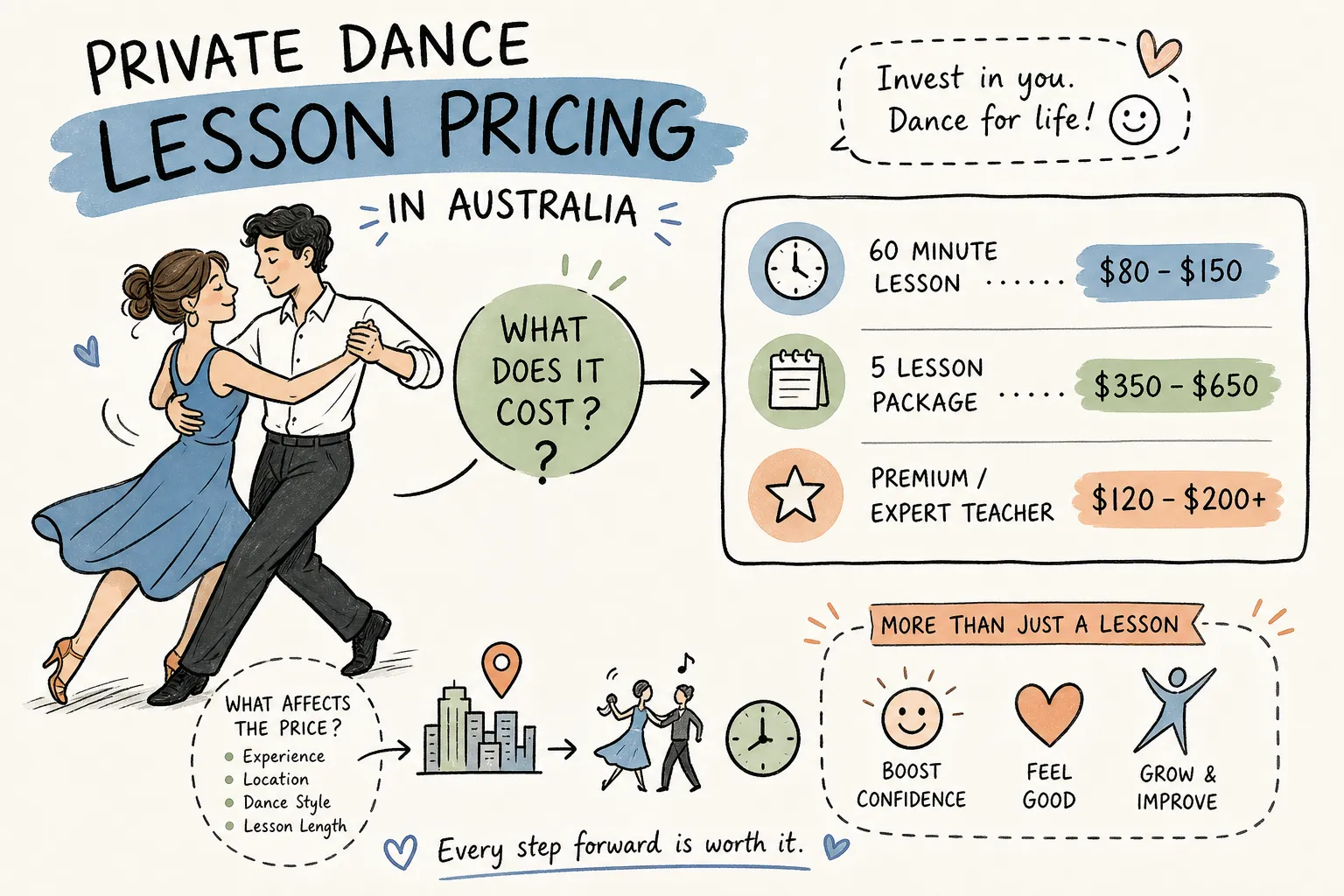
Private lesson pricing Australia-wide is genuinely confusing. Many studio websites either bury their rates three clicks deep or give you a vague “contact us for pricing” that tells you nothing. That’s frustrating when you’re trying to make a straightforward decision about whether a lesson is worth your money.
The honest answer is that private lesson pricing Australia varies from around $60 to $180 per hour depending on where you are, who’s teaching, and what format you choose. That’s a wide spread, and it exists for real reasons. A casual private lesson at Salsa Suave Dance Studio in the Sydney CBD sits at $140 with a specialist instructor who has spent over two decades teaching Latin dance. That’s a useful benchmark, it’s not cheap, but it reflects what quality Latin dance tuition actually costs in a professional city-centre studio.
This guide breaks down what you can expect to pay across Australian cities, how format and experience affect the rate, what lesson packages actually cost, and how to spot whether a quoted price is fair before you commit.
What private lesson pricing Australia looks like across cities
Sydney and Melbourne sit at the top of the national pricing range. One-on-one dance tuition with an experienced instructor runs $80 to $150 per hour in these cities, with premium CBD studios occupying the upper end of that bracket. Brisbane and Perth come in at $65 to $130 per hour, and Adelaide tends to offer the most accessible lesson fees per hour Australia-wide, typically $55 to $110. These figures reflect professional instructors with genuine credentials, not hobbyist teachers listed on generic tutoring platforms.
The “per hour” framing matters more than it seems. Many instructors charge a minimum session fee regardless of how long you actually book, so a 30-minute lesson is rarely half the price of a 60-minute one. Nationally, 30-minute dance lessons average $40 to $70, 45-minute sessions run $60 to $95, and 60-minute lessons sit between $75 and $130 in major cities. Longer sessions deliver disproportionately better value per minute. A 60-minute block is the minimum worth booking if you’re an adult learning a new style from scratch, you spend the first 10 minutes warming up regardless of lesson length, so shorter sessions compress your actual learning time significantly.
Sydney CBD studios reflect a combination of premium overheads, high-calibre instructors, and a location that’s genuinely accessible. That’s why a studio like Salsa Suave, with over 20 years of specialist Latin dance teaching behind it, operates at the $140-plus casual rate. The price reflects a real product, not inflated marketing.
What drives a dance instructor’s rate up or down
Instructors new to teaching typically charge $60 to $85 per hour. Once you move into instructors with a decade or more of teaching history, recognisable performance credentials, or a background in competitive Latin dance, you’re looking at $100 to $160 per hour. The gap is real and it’s earned. Dance instruction differs from academic tutoring in one important way: formal qualifications matter far less than demonstrable experience, competition history, and a track record of actually improving students.
Fernando Providel at Salsa Suave is a clear example of this principle. More than two decades of specialist Latin dance instruction and a consistent record of student outcomes justify a rate that sits above the Sydney metro average. That’s not marketing language, it’s the straightforward result of what separates a specialist from a generalist. You’re paying for compressed learning: fewer lessons to reach the same result.
The dance style also plays a role. Salsa, bachata, and cha-cha-cha each require different technical depth to teach effectively. Styles with complex timing structures or performance-level choreography, such as a wedding first dance routine, attract a modest premium from experienced instructors because the preparation and precision required are genuinely higher. Studios offering multiple Latin styles under one roof often deliver better long-term value than booking separate specialists for each style you want to learn.
Studio, in-home, and online: how format shifts the cost
Studio lessons represent the most stable and consistent pricing tier. In major cities, expect $80 to $150 per hour in a professional studio environment. The advantage of a purpose-built space with sprung floors, mirrors, and a proper sound system is frequently undervalued when people compare raw hourly rates across formats. These aren’t amenities, they’re functional requirements for learning certain movements correctly.
In-home versus studio pricing is more nuanced than it first appears. While in-home lessons can avoid studio hire costs, instructors who travel typically add a call-out or travel fee of $10 to $50 per visit to cover their time and transport. If you’re considering this format, confirm upfront whether a travel charge applies and factor it into your total lesson cost. Beyond cost, in-home lessons for partner dances carry a practical problem: most living rooms don’t provide adequate floor space, and furniture rearrangement limits what a skilled instructor can actually demonstrate or correct in a given session.
Online dance tuition generally runs roughly 10 to 20 per cent cheaper than in-person equivalents nationally. That sounds appealing, but the format has real limitations. Online lessons suit intermediate dancers refining technique or learning a specific sequence; they’re genuinely inadequate for complete beginners who need real-time physical correction on footwork and partner connection. If you’re starting from zero, online tuition is a false economy. You’ll spend more lessons fixing habits that a good instructor would have caught in person during the first session.
Lesson packages vs casual bookings: where the value actually lives
A single casual lesson is always the most expensive cost-per-session option available. A beginner who books ten individual sessions without a package is leaving meaningful money on the table. Casual lessons make sense for one specific purpose: testing a new studio or instructor before committing to anything longer. Once you’ve confirmed the fit, moving to a package is almost always the smarter financial decision.
At Salsa Suave, lesson packages range from a single $140 casual session through to multi-lesson bundles that bring the per-session cost down substantially while locking in consistent tuition with the same instructor throughout. The structure rewards commitment with real savings rather than cosmetic discounts.
Couples and pairs learning together get particularly strong value from private tuition. Two people in a single private session effectively halves the per-person cost without sacrificing the personalised teaching format that makes private lessons worth the price in the first place. When evaluating any package, calculate the effective cost per session and compare it directly to the casual rate. A well-structured bundle from a quality studio typically delivers 15 to 30 per cent savings per lesson, and that compounds quickly across a 10 or 20-lesson programme.
Hidden costs that can catch you off guard
Many studios charge a non-refundable booking or admin fee ranging from $50 to $100 to secure your lesson time, particularly for private tuition. This is commonly charged across the industry, not necessarily a red flag, but it needs to be factored into your total cost from the outset. Don’t let it surprise you after you’ve already decided to book.
Cancellation policies vary significantly. Most professional studios require 24 hours’ notice; late cancellations commonly incur 50 per cent of the session fee, and some charge the full amount. Read the cancellation policy before you sign anything. A studio with a clear, published policy is telling you something about how it operates. Vague or verbal-only policies are worth questioning before you hand over any money.
GST is usually included in advertised rates for registered businesses, but it’s worth confirming this upfront, particularly with freelance or independent instructors who may operate under the GST threshold and therefore don’t include it. Private dance tuition often carries minimal material costs for standard lessons, though wedding choreography sessions may include a small coordination or choreography fee on top of the lesson rate.
Some studios also build complimentary access to social dance nights or practice evenings into their packages. That adds genuine value that doesn’t appear in the headline price and is worth factoring into any comparison.
How to tell whether a quoted price is fair
A fair rate for private dance instruction in the Sydney CBD sits between $100 and $160 per hour for an experienced specialist in a premium studio. If a rate falls significantly below that, it’s worth asking why. It may reflect a newer instructor, limited teaching experience, or a trade-off in the studio environment. That’s not necessarily a problem, but it should be a conscious choice rather than an assumption that all instructors at similar prices are equivalent.
Transparent pricing published upfront on a studio’s website is itself a quality signal. Studios that are confident in their value don’t hide their rates or make you call to find out what a lesson costs. That transparency extends to policies: a reputable studio will answer straightforward questions about cancellations, package terms, and instructor experience without hesitation.
A few questions worth asking before booking any instructor or studio: How long have you been teaching this specific style? What is the cancellation policy and is the booking fee refundable? Can I trial a single session before committing to a package? Vague or evasive answers to any of these are a reliable early warning sign. Experienced studios answer all three clearly because they have nothing to hide.
The bottom line on private lesson pricing Australia
Private lesson pricing Australia-wide runs from roughly $60 to $150-plus per hour for quality instruction, with Sydney and Melbourne sitting at the upper end of that range. The real variable is not the city, it’s the instructor’s experience and the format. A two-decade specialist teaching in a purpose-built CBD studio is a genuinely different product from a generalist instructor at a similar hourly rate, and the difference shows up in how quickly you actually progress.
For anyone serious about learning Latin dance in Sydney, Salsa Suave Dance Studio offers a clear, transparent pricing structure with genuine flexibility. A single $140 casual session lets you test the fit before committing, and a range of multi-lesson packages brings the per-session cost well below the casual rate for students who are ready to commit. The studio is located in the Sydney CBD, and classes run seven days a week.
Once you understand what actually drives lesson costs, finding fair value in this lesson price guide Australia becomes straightforward. You’re not just buying an hour of someone’s time, you’re buying the shortest path to where you want to be on the dance floor.
 CALL US1300 724 442
EMAIL US info@salsasuave.com.au
VISIT US::
CALL US1300 724 442
EMAIL US info@salsasuave.com.au
VISIT US:: 
